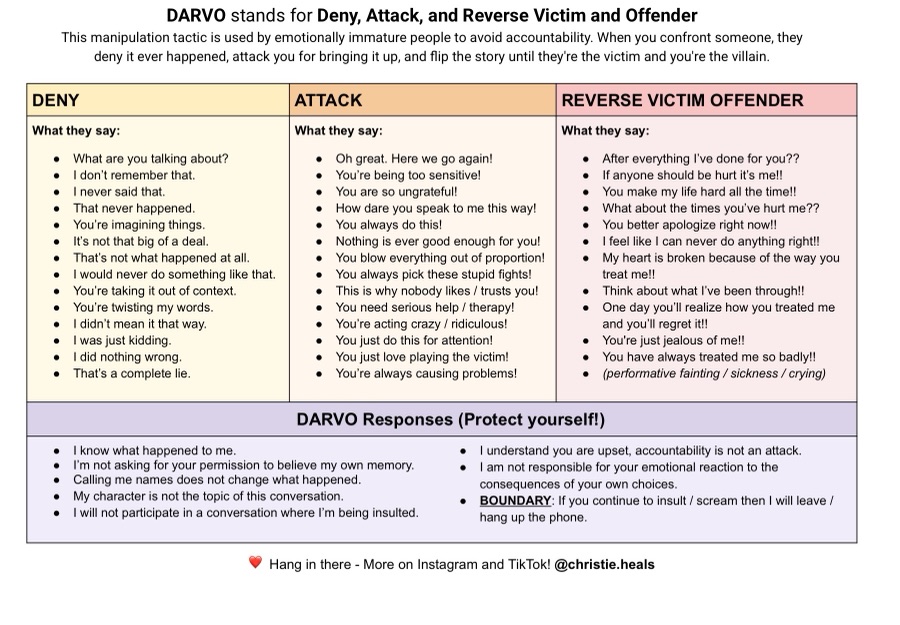
What does DARVO stand for?
DARVO stands for Deny, Attack, and Reverse Victim and Offender. It is a manipulation tactic used to avoid accountability: when you confront someone, they deny it happened, attack you for bringing it up, and flip the story until they are the victim and you are the villain.
What is DARVO in psychology?
DARVO is a term from psychology research for a pattern of response to being held accountable. The psychologist Jennifer J. Freyd introduced it in a 1997 paper on betrayal trauma theory, and Freyd's team has studied it since 2017. It describes a pattern, not a diagnosis.
What is an example of DARVO?
You tell someone their comment hurt you. They say "That never happened" (deny), then "You're being too sensitive!" (attack), then "After everything I've done for you??" (reverse victim and offender). Now the conversation is about their feelings, not what they did.
How do you respond to DARVO?
Stay on your own reality and refuse the new topic. Christie's lines include "I know what happened to me," "Calling me names does not change what happened," and "My character is not the topic of this conversation." If it continues, state a boundary and leave the conversation.
Who came up with the term DARVO?
The term DARVO was introduced by psychologist Jennifer J. Freyd in a 1997 paper on betrayal trauma theory. Freyd is an emeritus professor of psychology at the University of Oregon, and her page says DARVO is now in the Merriam-Webster dictionary.
Is DARVO the same as gaslighting?
No, though they overlap. Gaslighting makes you doubt your memory or sanity. DARVO is a response to being held accountable, and only DARVO ends with the other person casting themselves as the victim. The "deny" step can be gaslighting.
Is DARVO abuse?
DARVO is a tactic, not a diagnosis, and by itself it does not prove abuse. Researchers link it to harmful behavior, and Christie calls it emotional abuse. Look at the pattern: how often it happens, whether it silences you, and whether you feel safe.
Do people who use DARVO know they are doing it?
Not necessarily. Christie says people who DARVO usually do not do it on purpose and that it is how they move through life. Researchers describe it as a reaction to being held accountable. Either way, intent does not erase the harm.
Is there a free DARVO cheat sheet?
Yes. Christie's free one-page DARVO cheat sheet lists 40+ real phrases for Deny, Attack, and Reverse Victim and Offender, plus responses that protect you. Add your email to download it.