The research behind DARVO.
DARVO was introduced by psychologist Jennifer J. Freyd in a 1997 paper, and Freyd's team has studied it since 2017. Studies find it is commonly reported when people confront wrongdoing, that more exposure goes with more self-blame, and that it can make observers believe victims less. Learning about DARVO seems to reduce its effect. Most studies involve sexual violence or college samples.

Where the term comes from
DARVO (Deny, Attack, and Reverse Victim and Offender) was introduced by Jennifer J. Freyd in a 1997 peer-reviewed article on betrayal trauma theory. Freyd is an emeritus professor of psychology at the University of Oregon and the founder and president of the Center for Institutional Courage.
The original paper is Freyd, J. J. (1997), "Violations of power, adaptive blindness, and betrayal trauma theory," Feminism & Psychology, 7, 22-32. Freyd's definition: DARVO refers to a reaction perpetrators of wrongdoing, particularly sexual offenders, may display in response to being held accountable. The perpetrator may deny the behavior, attack the person doing the confronting, and reverse the roles of victim and offender, so that the perpetrator takes the victim role and turns the true victim, or the whistleblower, into an alleged offender.
Freyd's own page also says that, as of 2026, DARVO is in the Merriam-Webster dictionary.
A timeline of the research
The concept appeared in 1997; empirical research began in 2017. These are the main studies listed on Freyd's DARVO page, with what each found, in plain language.
| Year | Study | What it found |
|---|---|---|
| 1997 | Freyd, Feminism & Psychology | Introduced DARVO in the context of betrayal trauma theory. |
| 2017 | Harsey, Zurbriggen & Freyd | DARVO was commonly used by people who were confronted; its three parts were correlated; more exposure to DARVO was linked to more self-blame in the confronter. |
| 2020 | Harsey & Freyd | Exposure to a DARVO response led to less belief of the victim and more blame of the victim. People who had learned about DARVO rated the perpetrator as less believable. |
| 2022 | Rosenthal & Freyd | Of 89 women assaulted in college, most had some contact with the perpetrator afterwards, and nearly half experienced DARVO tactics. |
| 2023 | Harsey & Freyd | Results similar to 2020 on DARVO's influence; insincere apologies had minimal impact on ratings. |
| 2024 | Harsey, Adams-Clark & Freyd | DARVO use was associated with sexual harassment perpetration and acceptance of rape myths in student and community samples. |
| 2026 | Durland, Harsey & Freyd | Introduced a short DARVO measure; DARVO exposure was linked to trauma symptoms and was higher in confrontations about emotional and psychological mistreatment. No link to gender or marginalized identity was found. |
Freyd also lists conference presentations not yet published in peer-reviewed journals, and an online DARVO research tracking page maintained through the Center for Institutional Courage.
What the studies say, in plain language
Five findings come up most: DARVO is common when people confront wrongdoing, the three parts tend to go together, hearing more of it goes with more self-blame, it can shift observers' judgments against victims, and learning about it can blunt the effect.
- It is common. Confronted people often responded with DARVO elements in the 2017 study, and nearly half of the women in the 2022 study reported it.
- The three parts go together. Deny, attack and reverse tended to occur together, which supports DARVO as a coherent pattern.
- More DARVO, more self-blame. The more DARVO the confronter heard, the more they tended to blame themselves. Freyd links this to how perpetrators can enforce silence.
- It sways observers. In experiments, DARVO led people to believe the victim less and blame them more.
- Education helps. Participants taught about DARVO rated the perpetrator as less believable. Freyd calls teaching better responses "Anti-DARVO."
These findings are why Christie's work matters to the topic. Teaching people what DARVO looks like, and what to say back, is a form of the education the studies point to. See how to respond.
Institutional DARVO and Anti-DARVO
Institutional DARVO is when an institution, or someone with its complicity, does the denying, attacking and reversing. Anti-DARVO means both reducing DARVO's impact and teaching more constructive responses to allegations.
Freyd calls institutional DARVO a form of institutional betrayal. This workplace and institutional side is touched on in DARVO at work.
What we do not know yet
Most research focuses on sexual violence and college samples, relies on self-report, and shows associations rather than causes. Findings about who is exposed differ between studies. Anyone quoting a single percentage for "how common DARVO is" should say which study it comes from.
- Narrow samples. Many studies involve undergraduates and sexual violence. Less is known about everyday family, friendship and workplace DARVO.
- Self-report. The main measures ask people what they heard during a confrontation, not what the other person intended.
- Correlation. Findings like the link between DARVO exposure and self-blame show an association, not proof of cause.
- Mixed findings on who is exposed. The 2017 study found women were more likely to be exposed than men, while the 2026 study found no association with gender.
- Conflicting figures online. You may see a percentage for how often DARVO is used. Websites quote different numbers for the same study, so this page uses only the figures on Freyd's own page.
DARVO is also a behavior pattern, not a diagnosis. See is DARVO abuse? and DARVO vs gaslighting for how it relates to other terms.
Where Christie's teaching fits
Christie isn't a researcher or a clinician. She translates the concept into plain words and scripts, drawn from her own experience of it, and she is upfront that she didn't invent it.
“I didn't create this. Some smart psychologist who's still alive created it.”Episode 14: DARVO and How to Respond to Losers
Her contribution is the part many explainers skip: the exact lines to use, and a description of what it feels like from the inside. Read how to respond to DARVO and the 40 phrases.
Keep going
- What is DARVO?: the definition, the three moves and the pillar guide.
- Is DARVO abuse?: what researchers say, what Christie says, and how to tell a moment from a pattern.
- DARVO vs gaslighting: and blame-shifting, projection, triangulation and reactive abuse, in one table.
- How to respond to DARVO: the exact lines, the if-then boundary and what not to do.
- DARVO at work: examples from bosses and coworkers, and how to respond and keep a record.
- The free DARVO cheat sheet: the phrases and responses on one printable page.
- The JADE technique: why not explaining yourself is part of the answer.
Sources and how this was written
This page summarizes the research that Jennifer Freyd lists on Freyd's own DARVO page, in plain language, and links to each study. Summaries are of abstracts and of Freyd's descriptions, not of full papers, so check the studies before relying on specific details. Christie's quote is checked against episode 14.
- Jennifer J. Freyd, "What is DARVO?": definition, history and the list of studies
- Freyd (1997), Feminism & Psychology, 7, 22-32: the original article, listed on Freyd's page
- Harsey, Zurbriggen & Freyd (2017)
- Harsey & Freyd (2020)
- Rosenthal & Freyd (2022)
- Harsey & Freyd (2023)
- Harsey, Adams-Clark & Freyd (2024), PLOS ONE
- Durland, Harsey & Freyd (2026)
- Center for Institutional Courage
This guide is educational and written from lived experience. It is not a substitute for therapy or professional care, and DARVO is a pattern, not a diagnosis. Christie is not a therapist. Read the disclaimer.
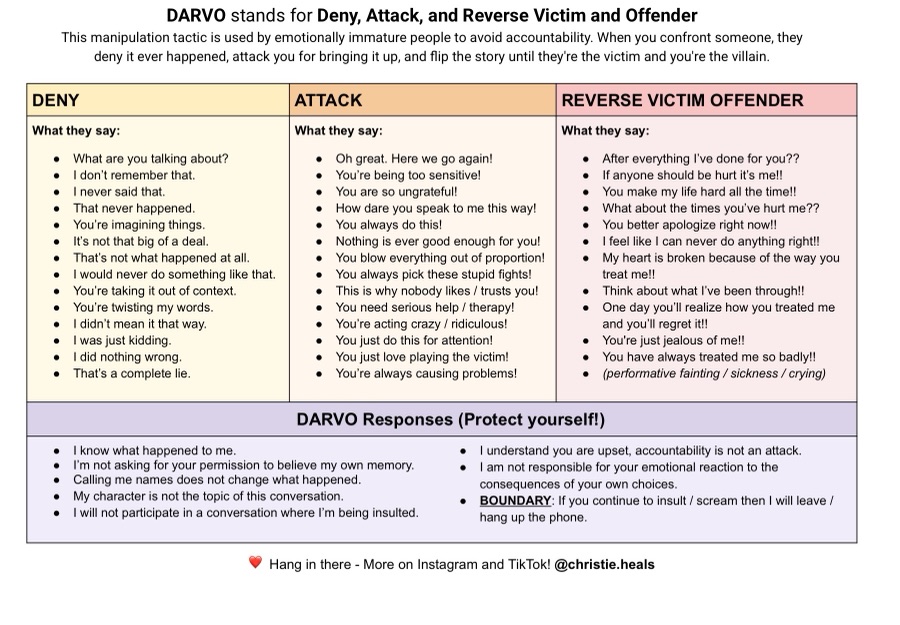
The DARVO cheat sheet.
What each step sounds like in a real conversation, and exactly what to say back. One page, free. Enter your email and it downloads right away.
- The three moves: Deny, Attack, Reverse Victim and Offender
- 40+ real phrases to listen for
- Responses that protect you, plus a boundary line
That didn't go through. Check the email address and try again.
Enter your email to get the cheat sheet.
We save your email so Christie can reach you. No spam. Privacy. Want the full community? Join the Patreon.The research behind DARVO, answered.
Who coined the term DARVO?
Psychologist Jennifer J. Freyd introduced DARVO (Deny, Attack, and Reverse Victim and Offender) in a 1997 article, "Violations of power, adaptive blindness, and betrayal trauma theory," in Feminism & Psychology. Freyd is an emeritus professor of psychology at the University of Oregon.
When was DARVO first used?
The concept was introduced in 1997. Empirical research began with a 2017 study by Harsey, Zurbriggen and Freyd, and the term was added to the Merriam-Webster dictionary in 2026, according to Freyd's page.
What does research say about DARVO?
Studies find DARVO is commonly reported when people confront wrongdoing, that more exposure is linked to more self-blame, that it can lead observers to believe victims less and blame them more, and that learning about DARVO can reduce its effect. Most studies involve sexual violence or college samples.
Is DARVO a real psychological term?
It is a term from peer-reviewed psychology research, introduced in 1997 and studied since 2017. It is not a clinical diagnosis. It describes a pattern of response to being held accountable.
What is Anti-DARVO?
Freyd uses Anti-DARVO to mean both ways of reducing the negative impact of DARVO and teaching more constructive responses to allegations. In one experiment, people taught about DARVO rated the perpetrator as less believable.
Who is Jennifer Freyd?
Jennifer J. Freyd is an emeritus professor of psychology at the University of Oregon and the founder and president of the Center for Institutional Courage. Freyd developed betrayal trauma theory, introduced DARVO, and has studied it with colleagues such as Sarah Harsey.