DARVO in relationships.
In a relationship, DARVO is when raising a problem with your partner ends with you apologizing. They deny it happened, attack you for bringing it up, then cast themselves as the hurt one. One heated argument is not a pattern. The same conversation shape, over and over, is.

What DARVO looks like with a partner
You raise something specific, such as plans changed without telling you or a comment that stung. The reply never touches it. It goes from "that didn't happen" to "what is wrong with you" to "after all I do for you," and you leave the conversation as the one who owes an apology.
Here is how the three moves can sound in a couple. The details change; the shape does not.
| Move | You say | They say |
|---|---|---|
| Deny | "You told me you'd pick up the kids and then you didn't answer your phone." | "I never said I would. You're remembering it wrong." |
| Attack | "I'm not remembering it wrong. I have the text." | "Wow. You always do this. You go looking for a fight." |
| Reverse Victim and Offender | "I'm just asking you to own it." | "I work all day for this family and the thanks I get is you interrogating me. I can never do anything right." |
Notice what is missing: any sentence about the kids, the phone or the text. By the end, the topic is your tone, your character and their hurt feelings. You can see the same moves as individual phrases on the DARVO examples page.
Why you end up apologizing
Because the conversation is built so that the only way to end it is to concede. When the topic switches from what they did to what is wrong with you, apologizing is the fastest way to make the pressure stop. Researchers have also found that the more DARVO someone hears, the more they blame themselves.
Christie describes her marriage this way:
“my marriage was just darvo every single day. I couldn't bring anything up that was upsetting me.”Episode 28: The Truth will Set You Free: Healing vs. Finances, Money is just energy, Leave at the first DARVO
“It was, I'm so ungrateful, what's wrong with me? I'm selfish, I'm the problem. That stuff kept me looping with him for a decade.”Episode 28: The Truth will Set You Free: Healing vs. Finances, Money is just energy, Leave at the first DARVO
That loop has a research basis. In a 2017 study, Harsey, Zurbriggen and Freyd found that higher exposure to DARVO during a confrontation was associated with greater self-blame in the person who confronted. Freyd's summary is that this is one way DARVO enforces silence. (See the research behind DARVO.)
Christie also names the sign that tells you it has happened to you:
“they darvo you and you end up apologizing for something they did to you.”Episode 19: Map of Human Consciousness, Dolly Parton and Taking your Phone in the Bathroom
Normal argument or DARVO? Five questions
Ask whether the original issue ever got discussed, whether you ended up apologizing, whether they can ever say "you're right," whether your character became the topic, and whether it has the same shape every time. Several yeses over time point to a pattern, not a bad night.
- Did the thing you raised ever get discussed? Or did the subject change within a minute or two?
- Did you end up apologizing, for your tone, your timing or for raising it at all?
- Can they ever say "you're right"? Not as a tactic to end the fight, but because they heard you.
- Did your character become the topic? "You always," "you never," "what's wrong with you."
- Is the shape the same every time? Different subject, same three moves.
Fairness matters here. Everyone gets defensive sometimes, including Christie, and one defensive reaction that is later repaired is not the same as a pattern. What separates them is what happens next. Christie's line is that people need to own what they did even when it was not intentional:
“intent does not erase harm”Episode 14: DARVO and How to Respond to Losers
If you want a quick read on a specific conversation, try the DARVO checker. It is a mirror, not a verdict.
What a healthy version sounds like
The other person gets curious instead of defensive. They say something like "that hurt your feelings, tell me more," and they stay for the whole conversation. You can disagree about facts and still have a repair.
Christie describes what she looks for now, after her divorce:
“hey, that hurt my feelings, or like, hey, that's not what I thought was gonna happen. Can we talk? And the person is full attention.”Episode 30: Big Feet, Bad Parents, and Why You Need to Stop Chasing Your Husband
“There's no Darvo, there's no, I never said that, that's not what happened.”Episode 30: Big Feet, Bad Parents, and Why You Need to Stop Chasing Your Husband
In her telling, the person who raises the issue shares how they felt, and the other person listens and stays curious instead of rushing to deny:
“the other person needs to listen and be curious about how they hurt your feelings and not rush straight to Darvo and say, you're overreacting, you're being unfair.”Episode 28: The Truth will Set You Free: Healing vs. Finances, Money is just energy, Leave at the first DARVO
For the full picture, including what a real apology contains, read what a real apology sounds like.
What you can do
Raise one issue at a time in plain words, use a short line when the topic switches, and watch what happens when you hold a boundary. The most useful information is how they respond when you refuse to take the bait.
- Speak up early and specifically. Christie: raising what you need is not a flaw, it is how relationships work.
- Use one line when the topic switches: "I know what happened to me." Then return to your point once, or stop.
- Hold an if-then. "If this turns into name-calling, then I'm going to take a break and we can try again later." Then take the break.
- Notice the repair, or the lack of it. Do they ever come back and own it?
“I speak up when I need something different in a relationship, because that's how relationships work.”Episode 28: The Truth will Set You Free: Healing vs. Finances, Money is just energy, Leave at the first DARVO
Christie also shares her personal rule, and she is clear that it is hers:
“when someone is willing to darvo, they'll do it again and again and again, and you'll just make exception after exception after exception until you lose yourself in the relationship and you're walking on eggshells.”Episode 28: The Truth will Set You Free: Healing vs. Finances, Money is just energy, Leave at the first DARVO
The scripts for each move are on how to respond to DARVO.
When it is more than a bad argument
If you are afraid of their reaction, walking on eggshells, being isolated, monitored or threatened, that is beyond a communication problem and deserves support from someone trained in abuse. A pattern of DARVO can be one part of that.
DARVO does not prove abuse on its own; see is DARVO abuse? for how to think about it.
Keep going
- What is DARVO?: the definition, the three moves and the pillar guide.
- How to respond to DARVO: the exact lines, the if-then boundary and what not to do.
- Is DARVO abuse?: what researchers say, what Christie says, and how to tell a moment from a pattern.
- What a real apology sounds like: Christie's four signs of repair, and what to do if you recognize yourself.
- DARVO vs gaslighting: and blame-shifting, projection, triangulation and reactive abuse, in one table.
- The free DARVO cheat sheet: the phrases and responses on one printable page.
- The JADE technique: why not explaining yourself is part of the answer.
Sources and how this was written
The quotes are Christie's, checked against the transcripts of the episodes named. The conversation table is an illustration written for this page, not a quote. Research claims come from Jennifer Freyd's own page.
- Jennifer J. Freyd, "What is DARVO?": summary of Harsey, Zurbriggen & Freyd (2017) on DARVO and self-blame
- The National Domestic Violence Hotline: confidential support and safety planning
This guide is educational and written from lived experience. It is not a substitute for therapy or professional care, and DARVO is a pattern, not a diagnosis. Christie is not a therapist. Read the disclaimer.
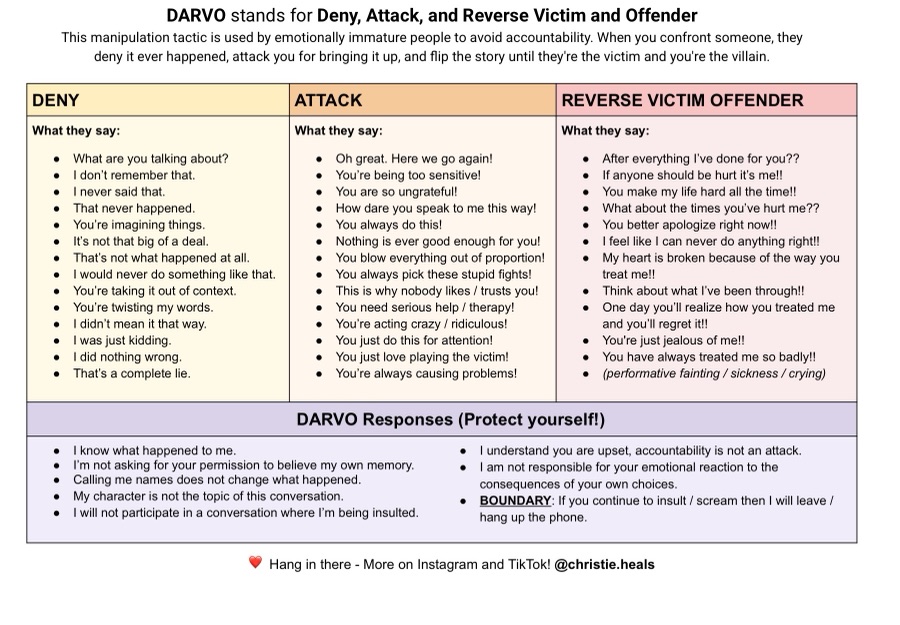
The DARVO cheat sheet.
What each step sounds like in a real conversation, and exactly what to say back. One page, free. Enter your email and it downloads right away.
- The three moves: Deny, Attack, Reverse Victim and Offender
- 40+ real phrases to listen for
- Responses that protect you, plus a boundary line
That didn't go through. Check the email address and try again.
Enter your email to get the cheat sheet.
We save your email so Christie can reach you. No spam. Privacy. Want the full community? Join the Patreon.DARVO in relationships, answered.
What is DARVO in a relationship?
In a relationship, DARVO is when raising a problem with your partner leads to denial ("that never happened"), an attack on you ("you're too sensitive"), and a flip in which they are the hurt one ("after everything I do for you"). It ends with you apologizing and the original issue unaddressed.
How do I know if my partner is using DARVO?
Look for a pattern across conversations: the original issue never gets discussed, your character becomes the topic, you end up apologizing, and they almost never say "you're right." One defensive moment is not a pattern. The same three moves repeating is.
Why do I feel like the problem after every argument?
Because DARVO moves the topic from what they did to what is wrong with you. Researchers have found that the more DARVO someone hears when they confront, the more they tend to blame themselves.
Does my partner know they are doing it?
Christie says people who DARVO usually don't do it on purpose, and that it is how they move through life. Researchers describe it as a reaction to being held accountable. Either way, the effect on you is the same, and what matters is whether they change when you name it.
Can a relationship survive DARVO?
Sometimes, if the person can recognize the pattern, own it and change. Christie's test of repair is: they listen, own it, say they will do better, and then do it. If every attempt at repair meets the same denial, attack and reversal, that tells you something.
Can I be the one doing DARVO?
Yes. Most people get defensive sometimes. If you recognize yourself, pausing before you answer, asking to hear more and owning what you did are the way out. See what a real apology sounds like.