Is DARVO abuse?
DARVO is a tactic, not a diagnosis, and by itself it doesn't prove abuse. Researchers link it to abusive and harmful behavior, and Christie Hoffman calls it emotional abuse. What matters is the pattern: how often it happens, whether it is used to silence or control you, and whether you feel safe to raise things.

What researchers say and what Christie says
Researchers describe DARVO as a reaction perpetrators of wrongdoing may display when held accountable, and have tied it to self-blame, trauma symptoms and, in some studies, sexual violence. Christie, from lived experience, calls it emotional abuse. These are two different kinds of statement, and both are useful.
Jennifer Freyd, who coined the term, defines DARVO as a reaction that perpetrators of wrongdoing may display in response to being held accountable. Freyd's team found that higher exposure to DARVO during a confrontation was associated with greater self-blame in the person confronting, and a 2026 study found DARVO exposure was linked to trauma symptoms and was higher in confrontations about emotional and psychological mistreatment. See the research behind DARVO.
Christie's view, which she states plainly:
“That's emotional abuse. Darvo is emotional abuse.”Episode 27: You Don't Have to Go Home for the Holidays (And You're Not a Bad Person)
She also says it in episode 26, listing it with other forms of abuse:
“darvo is emotional abuse, triangulation.”Episode 26: Birth Order, Toxic Family Roles and why you're going to be JUST FINE
The difference is scope. A researcher is describing a response to being confronted. Christie is describing what repeated DARVO does to a person over time, from the inside. A fair reading of both: DARVO is a tactic that can be part of emotional abuse, and when it is the standard way someone responds to you, it can wear you down in the way abuse does.
Why one instance isn't automatically abuse
Because defensiveness is human. Most people deny, deflect or get stung at some point. A single DARVO-like reaction, followed by a real apology, is a rough moment. A consistent way of responding to being held accountable is something else.
Christie is generous about this:
“we're all gonna mess up.”Episode 14: DARVO and How to Respond to Losers
“it's part of being a human, it's part of having relationships”Episode 14: DARVO and How to Respond to Losers
What she asks for is what happens next. The test is repair, not perfection; see what a real apology sounds like.
Do people know they are doing it?
Often not, in Christie's view, and the research frames DARVO as a reaction, not necessarily a plan. But intent doesn't change the effect on the person hearing it, and it doesn't excuse the harm.
“People who Darvo, they don't do it on purpose. It's just how they move through life.”Episode 28: The Truth will Set You Free: Healing vs. Finances, Money is just energy, Leave at the first DARVO
“this is not something people even do on purpose.”Episode 14: DARVO and How to Respond to Losers
Researchers have mostly measured what a person heard during a confrontation, not what the other person intended. That means research tells us more about the effect of DARVO than about motive. Christie's line on why motive isn't the point:
“intent does not erase harm”Episode 14: DARVO and How to Respond to Losers
In practice, you can believe someone isn't scheming and still decide you will not keep taking the hit.
A moment or a pattern?
Look at frequency, repair, whether it silences you, and whether it escalates. A pattern is the same response, over and over, with no repair, in a way that stops you raising things at all.
| A rough moment | A pattern | |
|---|---|---|
| How often | Now and then, usually when stressed. | The default response whenever you raise something. |
| Repair | They come back, listen and own it. | They almost never say "you're right." If they apologize, it is quickly followed by "but." |
| Effect on you | You feel hurt but heard in the end. | You stop raising things. You apologize first. |
| Escalation | It cools down. | It escalates to threats, silent treatment, public blame or recruiting others. |
| Safety | You can speak up and be safe. | You feel afraid of the reaction or are walking on eggshells. |
“you'll just make exception after exception after exception until you lose yourself in the relationship and you're walking on eggshells.”Episode 28: The Truth will Set You Free: Healing vs. Finances, Money is just energy, Leave at the first DARVO
If you want a quick read on one conversation, try the DARVO checker. If you are asking the bigger question about a whole relationship, it is worth speaking to someone trained in abuse.
Power, control and safety
The most useful questions are about power: can you disagree without fear, does the other person monitor or isolate you, do they control money or threaten you, and do you change your behavior to avoid their reaction? DARVO alongside any of these deserves support from an advocate.
“Nobody should be making you feel sick. Pay attention to that.”Episode 14: DARVO and How to Respond to Losers
She is also clear that she is not telling you to cut everyone off tomorrow. If your situation is about safety rather than communication, the hotline below can help you think it through.
Keep going
- What is DARVO?: the definition, the three moves and the pillar guide.
- The research behind DARVO: who coined it, a timeline of the studies and what is still unknown.
- DARVO in relationships: with a partner or spouse: examples, why you apologize, and what healthy repair sounds like.
- What a real apology sounds like: Christie's four signs of repair, and what to do if you recognize yourself.
- How to respond to DARVO: the exact lines, the if-then boundary and what not to do.
- The free DARVO cheat sheet: the phrases and responses on one printable page.
- The JADE technique: why not explaining yourself is part of the answer.
Sources and how this was written
Christie's statements are quoted from the episodes named and are her views from lived experience. Research claims come from Jennifer Freyd's own page and the studies it lists. Neither is a diagnosis, and this page does not say whether any particular person is abusive.
- Jennifer J. Freyd, "What is DARVO?": definition and the research summaries cited above
- Harsey, Zurbriggen & Freyd (2017): DARVO and victim self-blame
- Durland, Harsey & Freyd (2026): DARVO exposure and trauma symptoms
- The National Domestic Violence Hotline: confidential support and safety planning
This guide is educational and written from lived experience. It is not a substitute for therapy or professional care, and DARVO is a pattern, not a diagnosis. Christie is not a therapist. Read the disclaimer.
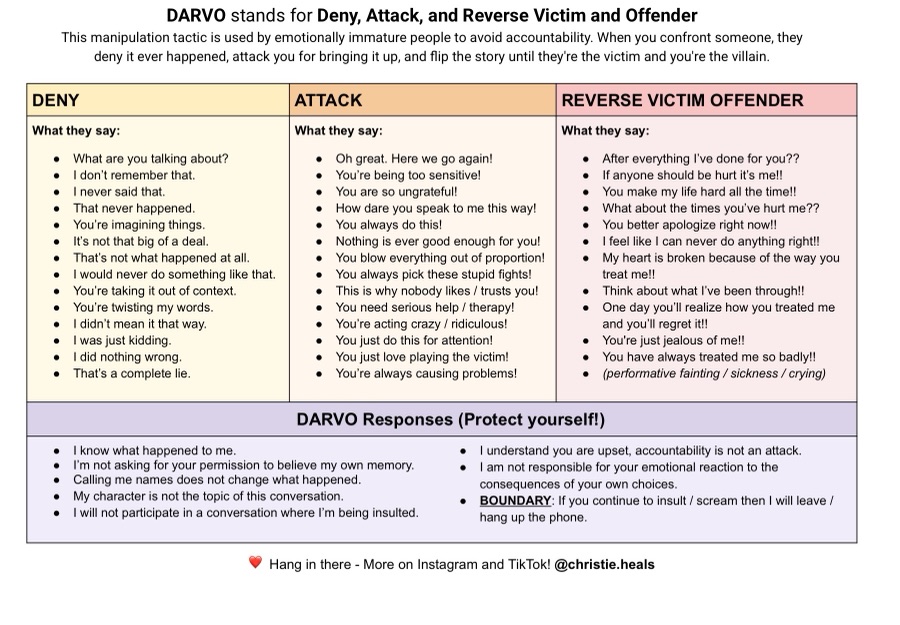
The DARVO cheat sheet.
What each step sounds like in a real conversation, and exactly what to say back. One page, free. Enter your email and it downloads right away.
- The three moves: Deny, Attack, Reverse Victim and Offender
- 40+ real phrases to listen for
- Responses that protect you, plus a boundary line
That didn't go through. Check the email address and try again.
Enter your email to get the cheat sheet.
We save your email so Christie can reach you. No spam. Privacy. Want the full community? Join the Patreon.Is DARVO abuse? Answered.
Is DARVO abuse?
DARVO is a tactic, not a diagnosis, and by itself it doesn't prove abuse. Researchers link it to abusive behavior and trauma symptoms, and Christie Hoffman calls it emotional abuse. Look at the pattern: how often it happens, whether it silences you, and whether you feel safe.
Is DARVO emotional abuse?
Christie says yes: "Darvo is emotional abuse." Researchers have found that DARVO exposure is linked to trauma symptoms and is higher in confrontations about emotional and psychological mistreatment. Repeated DARVO can be a part of emotional abuse. One defensive moment, followed by repair, is not the same thing.
Is DARVO always intentional?
Not necessarily. Christie says people who DARVO usually don't do it on purpose and that it is how they move through life. Researchers describe it as a reaction to being held accountable. Either way, intent does not erase the harm.
Who typically uses DARVO?
Anyone can. Research has focused on people who have caused harm in interpersonal settings, especially sexual violence, and has linked DARVO use to sexual harassment perpetration and belief in rape myths. A 2026 study found DARVO exposure was not associated with gender or marginalized identity.
Is DARVO only used by abusers?
No. Many people use defensive versions of it without being abusive, especially when they feel ashamed. What matters is whether it is the consistent response to being held accountable and whether it is used to silence you.