DARVO at work.
At work, DARVO is when raising a problem, such as a mistake, credit or a comment, gets you denied, attacked or painted as the difficult one. The usual advice applies with more formality: stay on specifics, keep a written record, and use calm, neutral wording. This page is general communication guidance only.

What DARVO looks like at work
You raise something specific, such as credit for your work, a missed handoff or a demeaning comment. The reply is that it did not happen, you are the problem, and the manager or coworker is the one under strain. You leave with the issue unresolved and your reputation in question.
| Move | What it can sound like at work |
|---|---|
| Deny | "I don't recall saying that." / "That's not how the meeting went." / "That was a joke, you know that." |
| Attack | "This is why people find you hard to work with." / "You're being very defensive." / "I'm concerned about your attitude." |
| Reverse Victim and Offender | "I have been nothing but supportive of you." / "I've been the one carrying this team." / "I'm the one who feels attacked here." |
These are illustrations written for this page, not Christie's quotes. Freyd's DARVO page lists a 2022 article, co-authored by Freyd, on DARVO in the healthcare workplace. (See the research page.)
Why it works so well in an office
Because the setting rewards calm and keeps few records. If you raise something emotionally and the other person stays composed, you can look like the unreasonable one. Having a boss or HR in the loop adds an audience that may not know the history.
Christie's perspective comes from outside the office, from family and friendships, but she makes one point that fits the workplace: the person who denies and attacks is protecting themselves.
“it's way too scary for most people to ever look in the mirror and be like, oops, I did that bad thing, sorry, and take accountability.”Episode 14: DARVO and How to Respond to Losers
That does not excuse it. It explains why it is common, and why a conversation about "what happened" can turn quickly into "what is wrong with you."
How to respond at work
Stay on one specific, observable fact; stay neutral in tone; refuse the topic change in professional language; and follow up in writing. Christie's lines are made for personal life. At work, use the same idea in a more formal register.
- Pick one fact. "On Tuesday, the draft went out without my name on it" beats "you always take credit."
- Use neutral words, with no labels and no guessing about motives.
- Follow up in writing. "Thanks for meeting today. To confirm, we discussed X and agreed Y." A short email creates a record of what was said.
- Keep your own notes with dates, what was said and who was present.
- Know your options. HR, a skip-level manager or an employee-assistance program, if your workplace has them.
The if-then boundary also works in formal wording: "If this conversation becomes personal, I'll need to end it and continue in writing." For the full method, see how to respond to DARVO.
When the person is your boss
If a manager uses DARVO, your leverage is limited. Keep records, avoid emotional escalation in the moment, and consider who else can see the pattern. If it affects your job or safety, take it beyond the one conversation.
Where the other person has power over your pay or promotion, being right in the room is not enough. Documentation, a witness to key conversations and a clear understanding of company policy matter more than winning the argument. Christie's own advice about not exhausting yourself explaining applies here too:
“Over-explaining is a form of begging”Episode 14: DARVO and How to Respond to Losers
DARVO as a team or culture problem
DARVO can happen at an institutional level, not only between two people. Jennifer Freyd calls it institutional DARVO when an institution, or someone with its complicity, denies, attacks and reverses the roles.
Freyd uses "institutional DARVO" for when an institution, or someone with its complicity, does the denying, attacking and reversing. Her example is police charging rape victims with lying. She also writes about institutional betrayal more broadly. If you reported something and the story has turned against you, that experience has a name. See the research behind DARVO for the sources.
Keep going
- What is DARVO?: the definition, the three moves and the pillar guide.
- How to respond to DARVO: the exact lines, the if-then boundary and what not to do.
- DARVO vs gaslighting: and blame-shifting, projection, triangulation and reactive abuse, in one table.
- The research behind DARVO: who coined it, a timeline of the studies and what is still unknown.
- Is DARVO abuse?: what researchers say, what Christie says, and how to tell a moment from a pattern.
- The free DARVO cheat sheet: the phrases and responses on one printable page.
- The JADE technique: why not explaining yourself is part of the answer.
Sources and how this was written
Christie speaks from personal and family life, not workplace experience. The workplace examples and adapted lines are written for this page and are marked as such. Research claims come from Jennifer Freyd's own page.
- Jennifer J. Freyd, "What is DARVO?": definition, including institutional DARVO
- Center for Institutional Courage: Freyd's center for research on institutional betrayal and institutional courage
This guide is educational and written from lived experience. It is not a substitute for therapy or professional care, and DARVO is a pattern, not a diagnosis. Christie is not a therapist. Read the disclaimer.
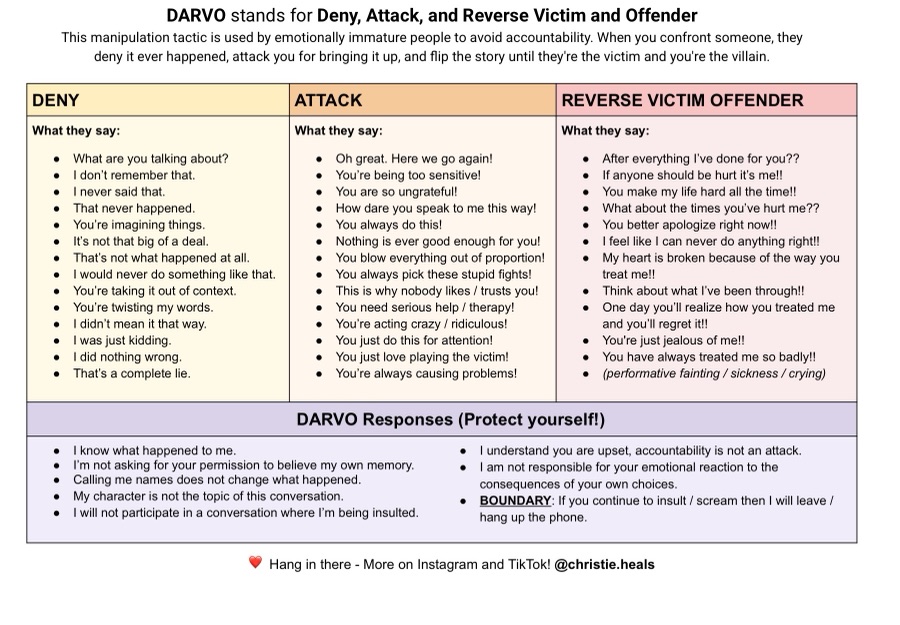
The DARVO cheat sheet.
What each step sounds like in a real conversation, and exactly what to say back. One page, free. Enter your email and it downloads right away.
- The three moves: Deny, Attack, Reverse Victim and Offender
- 40+ real phrases to listen for
- Responses that protect you, plus a boundary line
That didn't go through. Check the email address and try again.
Enter your email to get the cheat sheet.
We save your email so Christie can reach you. No spam. Privacy. Want the full community? Join the Patreon.DARVO at work, answered.
What is DARVO in the workplace?
DARVO at work is when raising a problem is met with denial ("I don't recall that"), an attack on you ("people find you hard to work with"), and a reversal in which the other person is the one who feels wronged. The issue you raised never gets addressed.
What are examples of DARVO at work?
A manager who says "I never said that," then "this is why people find you difficult," then "after everything I've done for you." A coworker who takes credit, denies it, then says you are attacking them. The pattern is deny, attack, reverse.
How do you respond to DARVO at work?
Stay on one specific fact, keep your tone neutral, decline the topic change in professional language ("I'd like to keep this about the issue, not about me"), follow up in writing and keep your own notes. Use HR or other channels if it continues.
Should I document DARVO at work?
Yes, as a matter of good practice. Keep dated notes of what was said and a short follow-up email after key conversations.