DARVO from your family.
Family DARVO is when telling a parent, sibling or in-law that something hurt you gets you blamed, guilted or labeled the problem. It is harder to spot because it comes with history, loyalty and an audience of relatives. The tools are the same as anywhere: one calm line, no explaining, and a boundary you follow through on.

Why DARVO from family hurts more
Because for many people it is the first conversation style they learned. If denying, blaming and flipping was how your family handled conflict, it can feel like normal communication, and calm, curious repair can feel strange.
“if Darvo's all you've ever known from childhood, you may not even know what healthy looks like.”Episode 14: DARVO and How to Respond to Losers
Christie describes a particular version from her mother, a kind of memory that conveniently fails when you bring up something she did:
“my mom used to get this convenient amnesia.”Episode 17: Physical reactions to arguments, raising kids in dysfunction, and psychedelics
Family DARVO also has an audience. A parent can deny, attack and reverse in front of siblings, in a group text or at a holiday table, and the people watching may take their side.
Christie's story: the question that started her obsession
Christie says her interest in DARVO began when her mother kept denying conversations that Christie knew had happened. Her own phrase for it: it is never about the thing, and then it becomes about you.
In episode 24 she describes telling her mother something private, then hearing it back from other people:
“if you're the only person I told there was a blue hippo in my room last night”Episode 24: If They Hate Your Boundaries, Let Them Go: Finding your voice, Alien Dreams, and Ghosting
When she raised it, the answer was "What are you talking about? I didn't say anything." In episode 21 she describes asking her mother direct questions and getting the same move, which she summarises like this:
“it's never about the thing. Then it becomes about you. That's Darvo.”Episode 21: A Deep Dive on my Mom
Where she ended up is not hatred:
“I don't hate her, I just can't let her into my orbit because she hurts me.”Episode 14: DARVO and How to Respond to Losers
The holiday guilt trip
When you tell family you will not be coming, the reaction is often DARVO in its purest form: you are dramatic, you are selfish, you are ruining everyone's holiday. You do not have to defend the decision. A short heads-up with no reasons is enough.
“And if you're called dramatic or too sensitive, you're getting darvoed.”Episode 27: You Don't Have to Go Home for the Holidays (And You're Not a Bad Person)
“Don't let people guilt you and shame you and manipulate you into going into abusive environments that you can't tolerate and you shouldn't.”Episode 27: You Don't Have to Go Home for the Holidays (And You're Not a Bad Person)
Her approach is to say it briefly and stop. The full script, and why leaving out the reasons matters, is on the JADE guide. The boundary format for when you do attend is the same if-then: if the yelling starts, you leave. See the boundaries cheat sheet.
Family lines to recognize
Family DARVO leans on obligation and history: "after everything we did for you," "I'm your mother," "you're tearing this family apart." These pair with the standard moves but add a layer of duty.
One of the lines Christie hears most:
“my mom tells me all the time, we gave you everything.”Episode 17: Physical reactions to arguments, raising kids in dysfunction, and psychedelics
These other examples are illustrations written for this page, not quotes:
When relatives take their side
Family DARVO often spreads: the person who denied and attacked tells their version to other relatives, who then pressure you. Christie calls them flying monkeys. Decide what you will discuss, set the boundary, and do not make a case to people who have only heard one side.
A flying monkey, in her definition, is someone who has heard one side of the story and been recruited to change your mind. See the glossary. Her view of the pressure they bring:
“That's making you the problem to someone else's actions.”Episode 24: If They Hate Your Boundaries, Let Them Go: Finding your voice, Alien Dreams, and Ghosting
Her boundary example for these calls is a plain if-then:
“if you bring up mom, then I need to get off the phone. And then you follow through.”Episode 24: If They Hate Your Boundaries, Let Them Go: Finding your voice, Alien Dreams, and Ghosting
And she warns about sharing your feelings with the person doing it:
“Don't tell them it hurt your feelings, that they talk bad about you. That's just ammunition for a smear campaign.”Episode 21: A Deep Dive on my Mom
A smear campaign is a deliberate attack on your character, one of the things DARVO's attack move can become.
Why you can't teach your parent what DARVO is
It is tempting to hand a parent the explanation, and Christie did. It did not work for her. Someone who protects themselves by denying is unlikely to take in a label for what they are doing, so your energy is better spent on your own responses.
“I even like printed her out an e-book and was like, this is Darvo, this is how you talk to me, this is why I get ticked off.”Episode 14: DARVO and How to Respond to Losers
She says it did not land, and she reached the same conclusion in episode 21:
“It's not your job to teach them, they're not gonna get it.”Episode 21: A Deep Dive on my Mom
That doesn't mean silence forever. It means your goal changes from getting them to understand to protecting yourself in the conversation. See how to respond to DARVO.
Siblings and in-laws
With siblings, DARVO often replays old family roles: the one who is "too sensitive" or "always the problem." With in-laws it often arrives as pressure from a couple, where raising an issue with one person gets you blamed by two. The tools are the same.
This section is general guidance rather than Christie's own words. If you grew up with a role like the scapegoat or the peacemaker, the family can slot you back into it the moment you speak up. Christie's toxic families hub gathers the episodes where she talks about those roles. With in-laws, pick one person to speak with, keep to one issue and use the same short lines.
If you're the parent being told this
Some parents read this and wonder if they did it. If your adult child says you hurt them, the useful response is to listen and ask to hear more before you explain, defend or deny. Christie says this directly to parents who wrote in.
In episode 17 she answers parents whose adult children have cut contact:
“Did you darvo her now that you know what that is?”Episode 17: Physical reactions to arguments, raising kids in dysfunction, and psychedelics
“Darvo alone will cause your kid to not want to talk to you.”Episode 17: Physical reactions to arguments, raising kids in dysfunction, and psychedelics
“can you do it without darvoing in your own head?”Episode 17: Physical reactions to arguments, raising kids in dysfunction, and psychedelics
Her practical advice is to recall what they said frustrated them and ask whether it was true. What a real apology sounds like covers what to do next.
Breaking the pattern with your own kids
Christie's family rule is that nobody can tell you your feelings are wrong or bad, and she practises hearing her kids out. The way to break the cycle is not to be perfect but to listen first.
“nobody can tell you that your feelings are wrong or bad. That's Darvo.”Episode 17: Physical reactions to arguments, raising kids in dysfunction, and psychedelics
“when my kids bring up things that upset them, I'm like full attention. I don't roll over and die.”Episode 26: Birth Order, Toxic Family Roles and why you're going to be JUST FINE
Keep going
- What is DARVO?: the definition, the three moves and the pillar guide.
- How to respond to DARVO: the exact lines, the if-then boundary and what not to do.
- What a real apology sounds like: Christie's four signs of repair, and what to do if you recognize yourself.
- Is DARVO abuse?: what researchers say, what Christie says, and how to tell a moment from a pattern.
- DARVO in friendships: what happens when you tell a friend they hurt you, and what a good friend does instead.
- The free DARVO cheat sheet: the phrases and responses on one printable page.
- The JADE technique: why not explaining yourself is part of the answer.
Sources and how this was written
The quotes are Christie's, checked against the transcripts of the episodes named. The lines in the table and the section on siblings and in-laws are written for this page and are marked as such. Where Christie states an opinion, it is hers.
- Jennifer J. Freyd, "What is DARVO?": on the definition of DARVO
This guide is educational and written from lived experience. It is not a substitute for therapy or professional care, and DARVO is a pattern, not a diagnosis. Christie is not a therapist. Read the disclaimer.
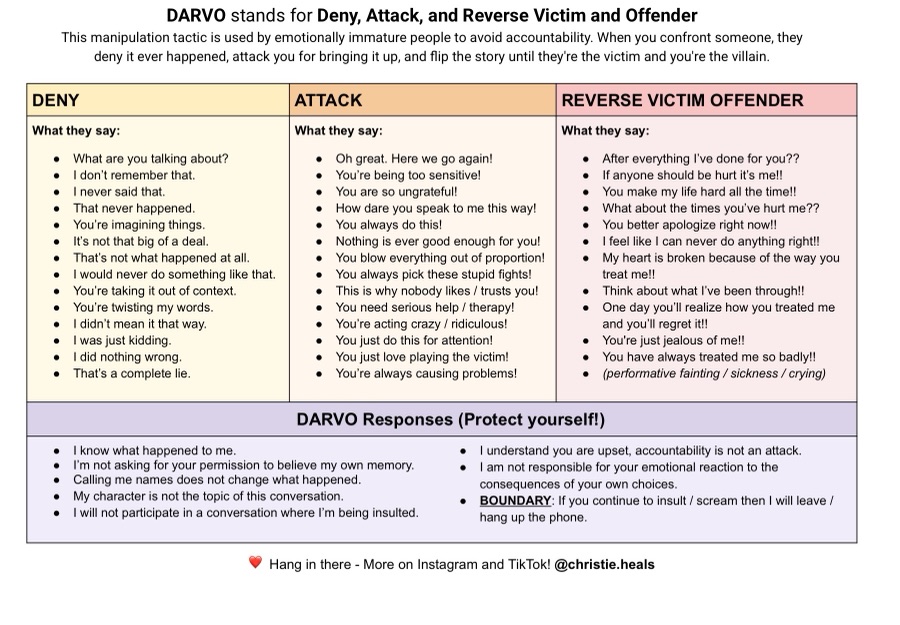
The DARVO cheat sheet.
What each step sounds like in a real conversation, and exactly what to say back. One page, free. Enter your email and it downloads right away.
- The three moves: Deny, Attack, Reverse Victim and Offender
- 40+ real phrases to listen for
- Responses that protect you, plus a boundary line
That didn't go through. Check the email address and try again.
Enter your email to get the cheat sheet.
We save your email so Christie can reach you. No spam. Privacy. Want the full community? Join the Patreon.DARVO from family, answered.
What is DARVO in a family?
Family DARVO is when telling a parent, sibling or in-law that something hurt you leads to denial ("that never happened"), an attack on you ("you're too sensitive"), and a reversal in which they are the wronged one ("after everything we did for you"). It is often backed up by other relatives.
Why does my mother deny things I know happened?
Christie calls her mother's version "convenient amnesia." Researchers describe denial as a common first reaction to being held accountable. You don't need to prove what happened to her. You can say, "I know what happened to me," and decide what the relationship can hold.
How do I respond when a parent uses DARVO on me?
Use one short line, such as "I'm not asking for your permission to believe my own memory," do not explain or defend, and use an if-then boundary if it escalates: "If you bring up my mother again, then I need to get off the phone." Then follow through.
What do I do about relatives who take their side?
Don't argue your case to people who have only heard one side. Christie's approach is a boundary: "If you bring up mom, then I need to get off the phone." You decide what you will discuss and with whom.
Do I have to go home for the holidays?
No. Christie's view, from episode 27, is that you are not a bad person for choosing what is best for you. A short heads-up that you have different plans, with no reasons attached, is enough.
I'm a parent and my adult child cut contact. Am I doing DARVO?
Ask whether you deny, attack or recast yourself as the hurt one when they raise something. Christie's advice to parents is to recall what your child said frustrated them, ask whether any of it is true, and listen before you explain. See what a real apology sounds like.