DARVO vs gaslighting.
Gaslighting makes you doubt your own memory or sanity. DARVO is a response to being held accountable: deny, attack, then reverse the roles of victim and offender. They overlap, because the "deny" step can be gaslighting, and sources disagree on whether DARVO is a kind of gaslighting or a separate tactic. Only DARVO has the final flip, where they become the victim.

The terms at a glance
These words describe different things that often travel together: what is done to your sense of reality (gaslighting), how someone escapes accountability (DARVO, blame-shifting), who else gets pulled in (triangulation), and how a reaction gets used against you (reactive abuse).
| Term | What it is | How it differs from DARVO |
|---|---|---|
| Gaslighting | Making someone doubt their memory, perception or sanity. | It targets your grip on reality. DARVO targets who is to blame. The "deny" step often is gaslighting. |
| DARVO | A three-move response to being held accountable: deny, attack, reverse victim and offender. | It ends with the role reversal, so you become the offender and they become the victim. |
| Blame-shifting | Moving responsibility onto someone or something else. | One move. DARVO is a sequence that includes blame-shifting plus denial and a full role reversal. |
| Projection | Seeing your own traits or feelings in another person. | It is an internal defense. DARVO is something said and done in a confrontation. |
| Triangulation | Pulling a third person into a conflict between two people. | It is about who else is involved. DARVO can use it: recruiting relatives to pressure you is one way the attack travels. |
| Stonewalling | Shutting down and refusing to engage. | It is avoidance. DARVO engages, but to turn the subject around. |
| Reactive abuse | A contested term for being provoked until you react, and then having the reaction treated as the problem. | It describes what happens after the provocation. DARVO is a response to being confronted. |
DARVO vs gaslighting, in detail
Gaslighting asks "are you sure that happened?" DARVO asks "how dare you bring it up?" One shakes your trust in your memory. The other shakes your right to be upset. A conversation can contain both.
Take a single conversation and label each move:
| What they say | What it is |
|---|---|
| "I never said that. You're remembering it wrong." | Deny, and gaslighting (it targets your memory). |
| "You're so sensitive. You're acting crazy." | Attack, and also gaslighting (it targets your sanity). |
| "After everything I've done, I'm the one who's hurt here." | Reverse victim and offender. This is DARVO only: it flips who is to blame. |
A rule of thumb, which is a simplification: gaslighting makes you distrust your memory; DARVO makes you distrust your right to be upset. The research origin of DARVO places it as a response to confrontation; gaslighting is a broader term. Don't worry about getting the label perfect. Christie's point is that you don't need the acronym in the moment:
“I'm confused. Things are escalating.”Episode 14: DARVO and How to Respond to Losers
If you recognize that feeling, you can use the same lines either way. See how to respond to DARVO.
Is DARVO a type of gaslighting?
It depends on who you ask. Some sources treat DARVO as a kind of gaslighting. Others treat it as a separate tactic that often appears alongside it. The terminology is not settled.
Jennifer Freyd, who coined DARVO, defines it as a reaction that perpetrators of wrongdoing may display when held accountable. Wikipedia's summary notes that the first stage, denial, involves gaslighting. Most plain-language explainers say DARVO and gaslighting commonly occur together. A fair way to put it: the denial step can be gaslighting, and DARVO adds the attack and the reversal. See the research behind DARVO.
Where reactive abuse fits
Reactive abuse is a contested term. It describes a real experience many people report, being provoked again and again until you react, and then being told your reaction is the problem. It overlaps with DARVO's attack and reversal.
Christie's definition, from her glossary entry:
“Reactive abuse is when someone creates a ton of issues, and then your reaction becomes like, oh my god, look at you, you're crazy.”Episode 11: Viral Chaos, ADHD is a Gift, & How to Stop Feeling Guilty After No Contact
Some advocates dislike the term because it can be used to excuse someone's own harmful behavior. Both things can be true: provocation is real, and your own behavior still matters. If you are worried about your own reactions, a real apology includes owning your part. Read Christie's definition in the glossary.
What people mean by "reverse DARVO"
"Reverse DARVO" is used in different ways: some writers mean a technique for responding to DARVO, others mean someone turning the DARVO label back on the person who named it. It is not a research term, so check what a particular writer means.
If someone answers "that sounds like DARVO" with "you're the one doing DARVO," that doesn't settle who is right. Look at who raised the original issue, who stayed on topic and who is willing to listen and repair.
Why labels help, and when they don't
A name makes a confusing pattern recognizable, which can be a relief. But a label is not a verdict on a person, and you do not need to say it out loud. Use it for yourself, then use plain words.
Researchers have found that knowing about DARVO makes a difference: in one experiment, people who had been taught about it rated the perpetrator as less believable than people who had not (Harsey & Freyd, 2020). Freyd calls this kind of education "Anti-DARVO." For the many forms the pattern takes, see DARVO examples, and for whether it counts as abuse, see is DARVO abuse?.
Keep going
- What is DARVO?: the definition, the three moves and the pillar guide.
- Is DARVO abuse?: what researchers say, what Christie says, and how to tell a moment from a pattern.
- The research behind DARVO: who coined it, a timeline of the studies and what is still unknown.
- How to respond to DARVO: the exact lines, the if-then boundary and what not to do.
- What a real apology sounds like: Christie's four signs of repair, and what to do if you recognize yourself.
- The free DARVO cheat sheet: the phrases and responses on one printable page.
- The JADE technique: why not explaining yourself is part of the answer.
Sources and how this was written
Definitions of the related terms are plain-language summaries written for this page. The one quote is Christie's, checked against episode 11 and episode 14. The research claims come from Jennifer Freyd's own page. The terminology is not fully settled, and this page says where sources disagree.
- Jennifer J. Freyd, "What is DARVO?": the term's definition and the 2020 education experiment
- Wikipedia: DARVO: general background; notes that the denial stage involves gaslighting
This guide is educational and written from lived experience. It is not a substitute for therapy or professional care, and DARVO is a pattern, not a diagnosis. Christie is not a therapist. Read the disclaimer.
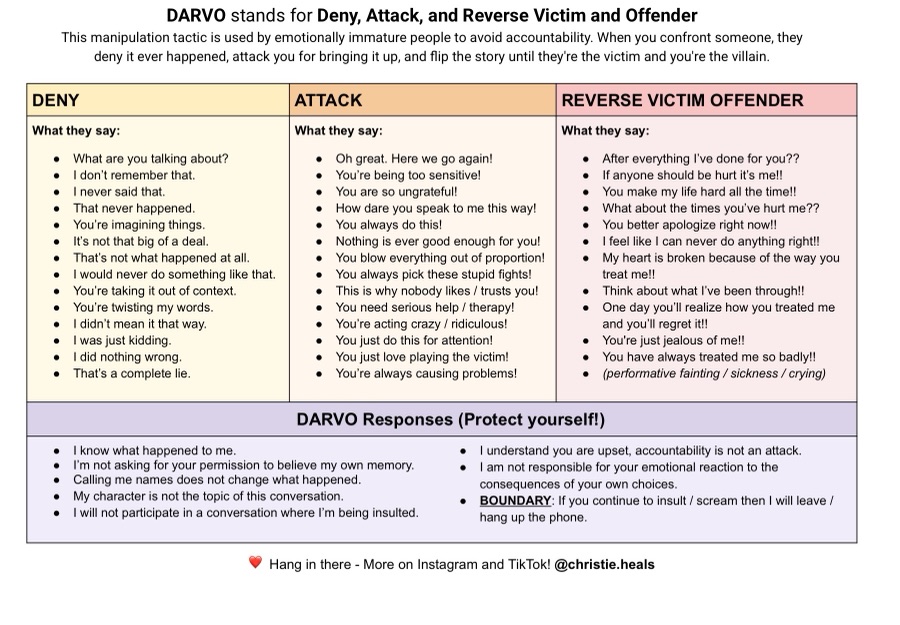
The DARVO cheat sheet.
What each step sounds like in a real conversation, and exactly what to say back. One page, free. Enter your email and it downloads right away.
- The three moves: Deny, Attack, Reverse Victim and Offender
- 40+ real phrases to listen for
- Responses that protect you, plus a boundary line
That didn't go through. Check the email address and try again.
Enter your email to get the cheat sheet.
We save your email so Christie can reach you. No spam. Privacy. Want the full community? Join the Patreon.DARVO and related terms, answered.
What is the difference between DARVO and gaslighting?
Gaslighting makes you doubt your memory, perception or sanity. DARVO is a three-move response to being held accountable: deny, attack, and reverse victim and offender. Only DARVO ends with the other person casting themselves as the victim. The two often occur together.
Is DARVO a type of gaslighting?
Sources disagree. Some treat DARVO as a form of gaslighting; others describe it as a separate tactic that often includes gaslighting, especially in the denial step. The terminology is not settled.
Is DARVO the same as blame-shifting?
No. Blame-shifting is one move: putting responsibility on someone else. DARVO is a sequence that includes denial, an attack on the person confronting, and a full reversal in which the offender claims to be the victim.
Is DARVO the same as projection?
No. Projection is an internal defense in which a person sees their own traits in someone else. DARVO is something said and done during a confrontation. A person could do both.
Is DARVO the same as reactive abuse?
No, but they overlap. Reactive abuse is a contested term for being provoked until you react and then having the reaction treated as the problem. DARVO is how someone responds when confronted. Both can involve being cast as "crazy."
What is triangulation?
Triangulation is pulling a third person into a conflict between two people, for example recruiting a relative to pressure you. It can be one way DARVO spreads, but it is a different tactic.