Was that DARVO?
Tick the things you heard in a conversation, and the checker shows which DARVO moves are present and what to say back. It is a mirror, not a diagnosis, and it works on one conversation, not on a person. Nothing you tick is saved or sent anywhere.

The DARVO checker
Think of one conversation where you raised something and came away confused. Tick anything that sounds like what you heard, then answer three quick questions.
Nothing you tick is saved or sent anywhere. This is a mirror, not a diagnosis.
How to read your result
One move may be a defensive moment. Two moves together start to look like a pattern. All three, in order, is the classic DARVO sequence. A single conversation can show the shape, but only repetition shows a pattern.
| Moves you heard | What it might mean | What to do |
|---|---|---|
| None | Nothing here matches the pattern. It may still have been a hard conversation. | If you came away confused, trust that and try again, one issue at a time. |
| One | A defensive moment. Many people get defensive when they feel blamed. | Watch what happens next. Do they come back and repair, or repeat? |
| Two | The start of the pattern. Deny plus attack, or attack plus reverse. | Use a short line and hold the topic. See how to respond. |
| All three | The full sequence: deny, attack, reverse victim and offender. | Name it to yourself, use one line and set a boundary if it continues. Consider whether it repeats across conversations. |
What this checker is not
It is not a diagnosis of you or the other person, and it cannot tell you whether someone is abusive. It describes the shape of one conversation. A pattern across many, and how someone responds when you name it, tells you far more.
Christie's own view is that you do not need the acronym in the moment. If you feel confused and things are escalating, that's the sign. Read is DARVO abuse? for how to think about what you find, and a real apology for what the opposite looks like.
“I'm confused. Things are escalating.”Episode 14: DARVO and How to Respond to Losers
Keep going
- What is DARVO?: the definition, the three moves and the pillar guide.
- How to respond to DARVO: the exact lines, the if-then boundary and what not to do.
- Is DARVO abuse?: what researchers say, what Christie says, and how to tell a moment from a pattern.
- What a real apology sounds like: Christie's four signs of repair, and what to do if you recognize yourself.
- DARVO in relationships: with a partner or spouse: examples, why you apologize, and what healthy repair sounds like.
- The free DARVO cheat sheet: the phrases and responses on one printable page.
- The JADE technique: why not explaining yourself is part of the answer.
Sources and how this was written
The phrases are from Christie's DARVO cheat sheet and episode 14. The three questions and the result text were written for this tool. It is a self-reflection aid, not a clinical instrument, and runs only in your browser.
- Jennifer J. Freyd, "What is DARVO?": the three-part definition the checker is based on
This guide is educational and written from lived experience. It is not a substitute for therapy or professional care, and DARVO is a pattern, not a diagnosis. Christie is not a therapist. Read the disclaimer.
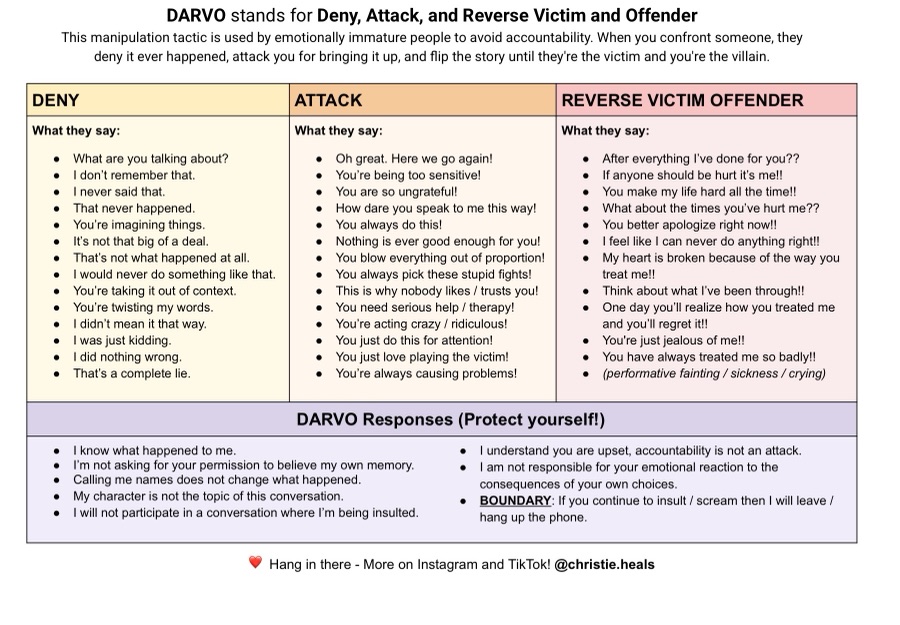
The DARVO cheat sheet.
What each step sounds like in a real conversation, and exactly what to say back. One page, free. Enter your email and it downloads right away.
- The three moves: Deny, Attack, Reverse Victim and Offender
- 40+ real phrases to listen for
- Responses that protect you, plus a boundary line
That didn't go through. Check the email address and try again.
Enter your email to get the cheat sheet.
We save your email so Christie can reach you. No spam. Privacy. Want the full community? Join the Patreon.The DARVO checker, answered.
Is there a DARVO test?
This page has a free DARVO checker. You tick the phrases you heard in one conversation, and it shows which of the three moves (deny, attack, reverse victim and offender) are present and gives a short line to say back. It is a self-reflection tool, not a clinical test.
What does the DARVO checker do?
It counts which DARVO moves appear in the phrases you tick and asks three questions about how the conversation went, such as whether the original issue was discussed and whether you ended up apologizing. It then explains what that pattern might mean.
Is my data saved?
No. The checker runs entirely in your browser. Nothing you tick is saved or sent anywhere.
Can the checker tell me if someone is abusive?
No. It describes the shape of one conversation. DARVO is a tactic, not a diagnosis, and by itself does not prove abuse. See "Is DARVO abuse?" for how to think about patterns, and contact a trained advocate if you feel unsafe.
What if I ticked everything?
Then the conversation followed the classic sequence: deny, attack, reverse victim and offender. Name it to yourself, use one calm line, and watch whether it repeats. Our guide to responding has the exact lines.