A real apology vs DARVO.
A real apology listens, owns what happened, says what will change, and then changes it. DARVO does the opposite: it denies, attacks and takes the victim role. Christie Hoffman's test is simple: they listen, they own it, they say they'll do better, and then they do it.

Christie's four signs of real repair
Christie's four signs are: they listen, they own it, they say they'll do better, and they do it. If any one is missing, the repair hasn't happened.
“They have to listen, own it, say that they'll do better, and then they do it.”Episode 14: DARVO and How to Respond to Losers
- They listen. They let you finish, ask what happened and stay for the whole conversation.
- They own it. "I did that, and I see why it hurt," with no "but."
- They say they'll do better. A specific commitment, such as "I'll tell you before I change plans."
- They do it. The next time looks different.
She says it matters because intent is not the point:
“intent does not erase harm”Episode 14: DARVO and How to Respond to Losers
And she says repair is what holds relationships together:
“Without repair, there's no relationship. Full stop.”Episode 14: DARVO and How to Respond to Losers
DARVO and repair, side by side
Take the same moment, someone saying "that hurt me," and compare the replies. DARVO answers the person. Repair answers the hurt.
These lines are illustrations written for this page, not quotes:
The repair replies don't require anyone to agree on every fact. They require the other person to stay curious and take the feeling seriously. Christie describes the kind of response she hopes for when she sets a boundary:
“they're gonna be like, oh my god, I'm so sorry immediately. Thank you for telling me, I won't do it again.”Episode 24: If They Hate Your Boundaries, Let Them Go: Finding your voice, Alien Dreams, and Ghosting
Non-apologies to watch for
A non-apology sounds like an apology but keeps the blame on you: "I'm sorry you feel that way," "I'm sorry, but you...," or "I said sorry, what more do you want?" Each moves the topic from what they did to how you are reacting.
- "I'm sorry you feel that way." It apologizes for your feeling, not their action.
- "I'm sorry, but you..." The "but" cancels the apology and starts the attack.
- "I said sorry, what more do you want?" It reverses the roles: now you are the unreasonable one.
- An apology followed by the same behavior. No change is the clearest sign.
In one set of experiments, Harsey and Freyd found that an insincere apology had minimal influence on how observers rated a fictional victim and perpetrator, while DARVO had a clear influence (Harsey & Freyd, 2023). Words matter less than what comes with them.
What if you recognize yourself?
Almost everyone does at some point. The way out is to slow down: notice the urge to deny, take a pause, ask to hear more, own your part without "but," and then do something differently. This is a communication skill, and you can learn it.
Christie is humble about her own record. She says she has gotten it wrong too, including with her kids:
“I've imperfectly messed up my kids in other ways.”Episode 26: Birth Order, Toxic Family Roles and why you're going to be JUST FINE
And she describes how she responds when they bring up something that upset them:
“when my kids bring up things that upset them, I'm like full attention. I don't roll over and die.”Episode 26: Birth Order, Toxic Family Roles and why you're going to be JUST FINE
- Notice the urge. The pull to say "that never happened" or "you're too sensitive" is the cue.
- Pause. "I need a minute to think about that" is allowed.
- Ask. "Can you tell me more about what that was like?"
- Own your part. Say what you did, in plain words, with no "but."
- Say what you will change, and then change it.
- Give it time. Trust returns slowly.
If shame is what stops you, you are not alone. Christie explains why it feels so hard:
“it's way too scary for most people to ever look in the mirror and be like, oops, I did that bad thing, sorry, and take accountability.”Episode 14: DARVO and How to Respond to Losers
If your adult child told you that you hurt them
The most useful thing you can do first is listen without explaining. Ask what happened, resist the urge to correct the details, and let them finish. Then repair. In her answers to parents, Christie asks them to recall what their child said frustrated them and to reflect honestly.
In episode 17 she is direct: "Darvo alone will cause your kid to not want to talk to you." For her full answers and what to do next, see DARVO from your family.
When repair isn't coming
If you have asked clearly more than once and each attempt meets the same denial, attack and reversal, the relationship may not be able to repair. That is information, not a failure on your part. Use short lines, boundaries, and decide how much access the person gets.
See how to respond to DARVO for the lines, is DARVO abuse? for how to think about the pattern, and Christie's walking away topic page for the episodes where she talks about the decision to step back.
Keep going
- What is DARVO?: the definition, the three moves and the pillar guide.
- How to respond to DARVO: the exact lines, the if-then boundary and what not to do.
- DARVO from family: mothers, parents, relatives who take sides, and the holiday guilt trip.
- DARVO in relationships: with a partner or spouse: examples, why you apologize, and what healthy repair sounds like.
- Is DARVO abuse?: what researchers say, what Christie says, and how to tell a moment from a pattern.
- The free DARVO cheat sheet: the phrases and responses on one printable page.
- The JADE technique: why not explaining yourself is part of the answer.
Sources and how this was written
The four signs of repair and the quotes are Christie's, checked against the transcripts of the episodes named. The side-by-side lines and the steps for recognizing yourself are written for this page and are marked as such. The research note comes from Jennifer Freyd's page.
- Harsey & Freyd (2023), Journal of Interpersonal Violence: on DARVO and insincere apologies
- Jennifer J. Freyd, "What is DARVO?": summary of the 2023 study
This guide is educational and written from lived experience. It is not a substitute for therapy or professional care, and DARVO is a pattern, not a diagnosis. Christie is not a therapist. Read the disclaimer.
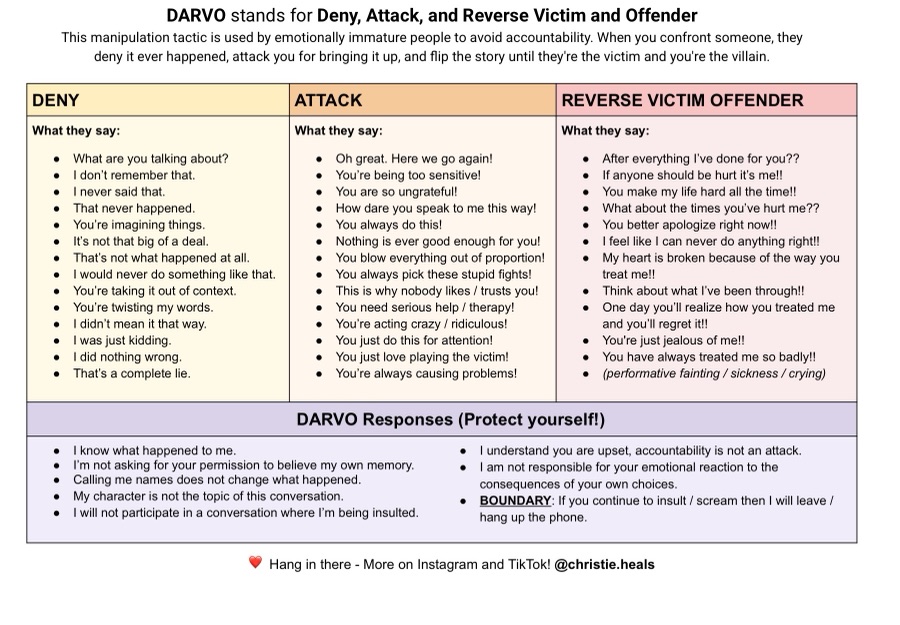
The DARVO cheat sheet.
What each step sounds like in a real conversation, and exactly what to say back. One page, free. Enter your email and it downloads right away.
- The three moves: Deny, Attack, Reverse Victim and Offender
- 40+ real phrases to listen for
- Responses that protect you, plus a boundary line
That didn't go through. Check the email address and try again.
Enter your email to get the cheat sheet.
We save your email so Christie can reach you. No spam. Privacy. Want the full community? Join the Patreon.Real apologies and DARVO, answered.
What does a real apology sound like?
A real apology names what you did, acknowledges the impact, takes responsibility without "but," says what you will change, and is followed by changed behavior. For example: "I did that, I can see why it hurt, I'm sorry, and I'll tell you before I change plans next time."
What is the difference between an apology and DARVO?
An apology listens and owns the harm. DARVO denies it happened, attacks the person raising it, and recasts the person who did the harm as the victim. An apology answers the hurt. DARVO answers the person.
What if I am the one who uses DARVO?
Almost everyone gets defensive sometimes. Notice the urge to deny or blame, pause, ask the other person to tell you more, own your part without "but," and then change what you do.
Is "I'm sorry you feel that way" an apology?
No. It apologizes for the other person's feeling instead of your action and often keeps the blame on them. A real apology names what you did.
Why can't some people apologize?
Christie's view is that for many people it feels too scary to look in the mirror and admit they did something wrong, so they protect themselves by denying, attacking or playing the victim. That doesn't excuse it, but it explains why it is common.