DARVO in friendships.
In a friendship, DARVO is when telling a friend they hurt you gets you rage, blame or a story about you told to other people. A good friend can be defensive for a minute and come back. A DARVO friend turns your honesty into the offence. How they react to being told tells you what the friendship can hold.

What DARVO looks like between friends
You tell a friend, gently, that something they said or did upset you. Instead of "I'm sorry, tell me more," you get "that's not what I said," "you're overreacting," and then "how dare you, after everything I've done for you."
Christie describes two friendships where she did exactly that, and what came back:
“both of their reactions were explosive rage at me. Darvo, how dare you?”Episode 28: The Truth will Set You Free: Healing vs. Finances, Money is just energy, Leave at the first DARVO
In one case, she says, the fallout went public: one of them started a smear campaign online, which she chose to ignore. She is clear that she did not raise either issue lightly:
“I do speak up early when something makes me uncomfortable”Episode 28: The Truth will Set You Free: Healing vs. Finances, Money is just energy, Leave at the first DARVO
The pattern to notice is what gets discussed. If the conversation about what you said never happens, and the topic becomes your tone, your loyalty or your character, that is the DARVO shape. See the examples for more lines.
What a good friend does instead
A good friend can be stung and still stay curious. They ask what they did, listen, and own it. Christie says that when someone cares about the friendship, they want to know what hurt you.
“the other person needs to listen and be curious about how they hurt your feelings and not rush straight to Darvo and say, you're overreacting, you're being unfair.”Episode 28: The Truth will Set You Free: Healing vs. Finances, Money is just energy, Leave at the first DARVO
“Intent doesn't erase harm.”Episode 28: The Truth will Set You Free: Healing vs. Finances, Money is just energy, Leave at the first DARVO
She also says that imperfect is fine. You do not have to deliver a hard message perfectly for a real friend to hear it. What a real apology sounds like lays out the signs of a genuine repair.
Christie's personal rule
Christie's own rule is that she speaks up when she needs something different and, if she gets DARVO'd, she lets the friendship go. She says this is her policy for herself, not advice for everyone.
“I speak up when I need something different in a relationship, because that's how relationships work.”Episode 28: The Truth will Set You Free: Healing vs. Finances, Money is just energy, Leave at the first DARVO
“And if I get darvoed, then I'm gone.”Episode 28: The Truth will Set You Free: Healing vs. Finances, Money is just energy, Leave at the first DARVO
“when someone is willing to darvo, they'll do it again and again and again, and you'll just make exception after exception after exception until you lose yourself in the relationship and you're walking on eggshells.”Episode 28: The Truth will Set You Free: Healing vs. Finances, Money is just energy, Leave at the first DARVO
She is also clear about whose job it is to fix the other person, and that it is not yours:
“it's not your job to heal people and get them to wake up and to educate them on what Darvo is”Episode 28: The Truth will Set You Free: Healing vs. Finances, Money is just energy, Leave at the first DARVO
Cutting off a friend is a big decision, and it doesn't need to be made after one argument. Wait, watch what they do next, and see whether the pattern repeats. If you want a quick read on a single conversation, use the DARVO checker.
What to say to a friend
Keep it brief and kind and don't re-argue. A short line protects you without ending a friendship that might be repairable. If the friend comes back with curiosity, you can talk. If they escalate, you can step back.
These are illustrations for a friendship, adapted from Christie's standard lines:
If it escalates, the if-then boundary applies to friends too: "If you keep raising your voice, then I'm going to end the call." More scripts are on how to respond to DARVO.
When the story spreads
DARVO between friends can turn public when the other person tells mutual friends their version. You can't control it. You can decide not to defend yourself to everyone who asks, and keep your own account short and consistent.
Christie says she ignored the campaign against her and that she will tell that story another day (episode 28). Her example suggests you do not have to answer every version. Keep your own account short and consistent. For the family version of this, see when relatives take their side.
Keep going
- What is DARVO?: the definition, the three moves and the pillar guide.
- How to respond to DARVO: the exact lines, the if-then boundary and what not to do.
- What a real apology sounds like: Christie's four signs of repair, and what to do if you recognize yourself.
- DARVO in relationships: with a partner or spouse: examples, why you apologize, and what healthy repair sounds like.
- DARVO from family: mothers, parents, relatives who take sides, and the holiday guilt trip.
- The free DARVO cheat sheet: the phrases and responses on one printable page.
- The JADE technique: why not explaining yourself is part of the answer.
Sources and how this was written
The quotes are Christie's, checked against the transcripts of the episodes named (mainly episode 28). The lines in the table are adaptations written for this page. Where Christie states a rule for herself, it is hers.
- Jennifer J. Freyd, "What is DARVO?": on the definition of DARVO
This guide is educational and written from lived experience. It is not a substitute for therapy or professional care, and DARVO is a pattern, not a diagnosis. Christie is not a therapist. Read the disclaimer.
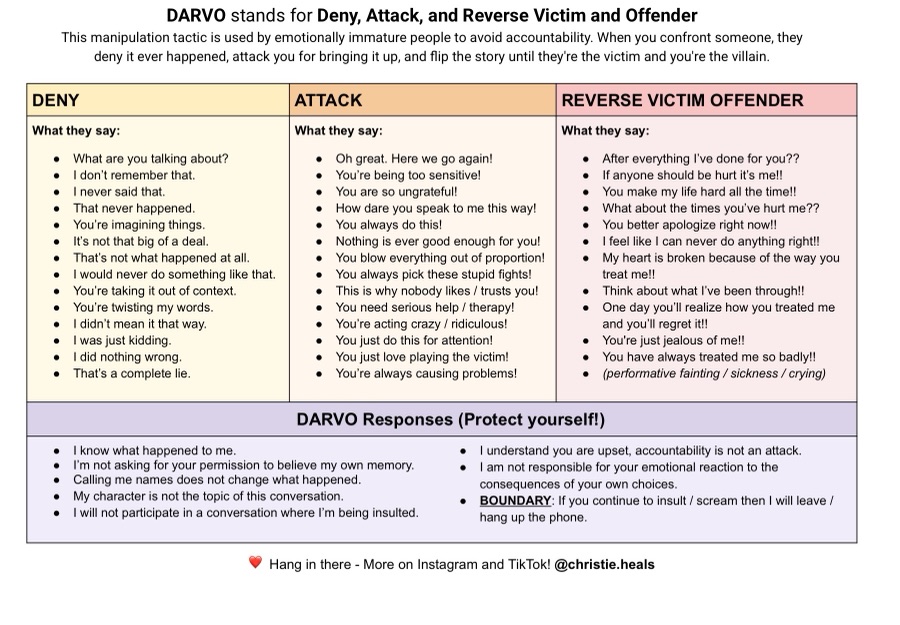
The DARVO cheat sheet.
What each step sounds like in a real conversation, and exactly what to say back. One page, free. Enter your email and it downloads right away.
- The three moves: Deny, Attack, Reverse Victim and Offender
- 40+ real phrases to listen for
- Responses that protect you, plus a boundary line
That didn't go through. Check the email address and try again.
Enter your email to get the cheat sheet.
We save your email so Christie can reach you. No spam. Privacy. Want the full community? Join the Patreon.DARVO in friendships, answered.
What is DARVO in a friendship?
In a friendship, DARVO is when telling a friend they hurt you is met with denial ("that's not what I said"), an attack ("you're overreacting"), and a flip in which they are the hurt one ("after everything I've done for you"). It can include telling mutual friends their version.
How do I respond to DARVO from a friend?
Keep it short and calm: "I know what happened to me. I'd like to hear how it landed for you." If they escalate, set an if-then boundary ("If you keep raising your voice, then I'm going to end the call") and follow through. Don't explain it again.
Is it DARVO if my friend just got defensive?
Not necessarily. Everyone gets defensive sometimes. The question is what happens next: do they come back, listen and own it, or does it repeat? One defensive reaction followed by repair is not a pattern.
Should I end a friendship over DARVO?
That is your decision. Christie's own rule is that if she is DARVO'd when she speaks up, she is done, because she says people who do it once do it again. She presents this as her policy, not advice. A single argument isn't enough to judge by; watch the pattern.
What if my friend tells other people their version?
You cannot control the story, but you can decide not to defend yourself to everyone. Christie ignored the campaign against her and kept to her own account. Keep yours short and consistent.