How to respond to DARVO.
Stay on what you know happened, refuse the new topic, and stop explaining. Say one calm line like "I know what happened to me," don't defend your character, and if it keeps escalating, set an if-then boundary and follow through. You don't have to win. You have to stay out of the trap.

The short version: three moves
Name your own reality in one line, refuse the topic change, and hold a boundary if it escalates. That is the whole method. Everything else on this page is how to do those three things when your heart is pounding.
- Name your reality. One short line, no evidence attached: "I know what happened to me."
- Refuse the new topic. The conversation started with what they did. DARVO moves it to what is wrong with you. You can decline the swap.
- Hold a boundary. If it keeps escalating, use an if-then: "If you continue to insult me, then I will leave." Then leave.
“Over-explaining is a form of begging, they don't want to understand you because they don't want to take accountability.”Episode 14: DARVO and How to Respond to Losers
Why arguing your case doesn't work
DARVO isn't a disagreement about facts, so more facts don't end it. Each move (deny, attack, reverse) changes the subject, and every new piece of evidence you offer gives the other person something new to deny, attack or flip.
Christie's explanation is that the two of you are doing different things in the same conversation:
“You're talking to connect and they're talking to win.”Episode 14: DARVO and How to Respond to Losers
That mismatch is why you walk away confused. You came to be understood. They came to avoid being held responsible. She describes the aftermath:
“Manipulation is where you bringing your hurt feelings to someone causes an argument where you leave feeling confused, upset, exhausted, further betrayed.”Episode 14: DARVO and How to Respond to Losers
It also helps to know your body may react before you do. Christie's episode on the four trauma responses names being DARVO'd as one of the moments they show up. If you tend to fight back, run, please or go blank, that is a nervous-system reflex, not a failure. Take the stress response quiz to see your default.
“these are the four identifiable protective responses that people tend to have in moments like when you're being darvoed”Episode 18: Trauma Responses (Fight, Flight, Fawn, Freeze)
What to say for each move
Match one calm line to the move you are hearing. These are Christie's own lines from episode 14 and her free cheat sheet: short, flat and impossible to argue with.
Say them flat and calm. Christie's note on the first one:
“Deadpan. No, I know what happened to me. Boom.”Episode 14: DARVO and How to Respond to Losers
You can see all 40 phrases and every response on the DARVO examples page, or keep them on one page with the free cheat sheet. One caution from her about the "I will not participate" line: don't add an insult of your own, because then you are insulting them right back. The point is to refuse the conversation, not to win it by attacking.
In the moment, step by step
Pause, say one line, do not re-argue the evidence, name the boundary if it escalates, and leave if it continues. Writing down what happened afterwards helps you trust your memory later.
- Pause. Unclench your jaw and breathe out slowly. You do not have to answer at the speed they are talking. "I need a minute" is a complete sentence.
- Say one line. Pick from the table above. Say it once, calmly.
- Don't re-argue the facts. If they deny again, you can repeat the same line or say nothing. More detail is more material for them to twist.
- Name the boundary if it escalates: "If you continue to insult me, then I will leave."
- Follow through. End the call, leave the room, or stop replying. A boundary you do not follow through on teaches them it is optional.
- Write it down afterwards. Date, what was said, how it ended. Notes you made close to the moment are easier to trust than a memory you have replayed fifty times.
The boundary: an if-then, and then you do it
A boundary is not a demand that someone change. It is a statement of what you will do: "If you continue to scream, then I will hang up." The if names the behavior, the then is your action, and you carry it out.
This is the format Christie uses for every boundary, and she repeats it for the holidays:
“a boundary follows an if-then format. If the voices start getting raised and people start yelling, then I'm gonna leave. And then if it happens, go get out of there.”Episode 27: You Don't Have to Go Home for the Holidays (And You're Not a Bad Person)
- In person: "If you keep raising your voice, then I am going to step outside."
- On the phone: "If you continue to insult me, then I will hang up. I am happy to talk when we can keep it respectful."
- With family: "If you bring up my mother again, then I need to get off the phone."
For more on how to deliver a boundary without justifying it, see the JADE technique and the boundaries cheat sheet.
How to respond to DARVO by text
In writing, keep replies short, answer only what you raised, and don't respond to each accusation. You can end the exchange without winning it. A text is permanent, so say less than you would out loud.
These are adaptations of Christie's lines for a message thread. They are not quotes from her:
- Don't send the long reply you drafted. If you need to write it, write it in your notes and don't send it.
- Stop at one message. If the replies pile up, that is the pattern, not a reason to answer each one.
- Save the thread. A record you did not have to rely on memory for is useful if you ever need to show what was said.
What not to do
Don't over-explain, don't insult back, don't try to teach them what DARVO is, and don't apologize for what they did. Each of these keeps you in the conversation they want.
- Don't justify, argue, defend or explain. That is JADE, and it is how the conversation drags on. Read the JADE guide.
- Don't educate them. Christie tried it and says it doesn't land.
- Don't apologize for something they did to you. If you have, you are not alone.
“that's not your job to even explain what Darvo is to them.”Episode 14: DARVO and How to Respond to Losers
“Don't tell them what Darvo is, they don't care.”Episode 21: A Deep Dive on my Mom
“they darvo you and you end up apologizing for something they did to you.”Episode 19: Map of Human Consciousness, Dolly Parton and Taking your Phone in the Bathroom
What if it doesn't work?
It may not, and that is useful information. The lines are not a spell that makes someone listen. They protect you in the conversation. How the person reacts after you hold a boundary tells you what the relationship can hold.
Christie is honest that the lines didn't change her mother:
“I remember saying these on my mom, by the way, and it didn't work, but it gave me a life jacket to survive the conversation.”Episode 14: DARVO and How to Respond to Losers
And she says to watch what happens when you set the boundary:
“the people who Darvo you, when you set a boundary, take note.”Episode 24: If They Hate Your Boundaries, Let Them Go: Finding your voice, Alien Dreams, and Ghosting
If it happens again and again, read is DARVO abuse? to think about what the pattern means, and DARVO in families or DARVO in relationships for the situation you are in. If the other person is genuinely listening, that is a different thing; see what a real apology sounds like.
Keep going
- What is DARVO?: the definition, the three moves and the pillar guide.
- DARVO examples: 40 phrases and the lines to say back.
- What a real apology sounds like: Christie's four signs of repair, and what to do if you recognize yourself.
- DARVO from family: mothers, parents, relatives who take sides, and the holiday guilt trip.
- Is DARVO abuse?: what researchers say, what Christie says, and how to tell a moment from a pattern.
- The free DARVO cheat sheet: the phrases and responses on one printable page.
- The JADE technique: why not explaining yourself is part of the answer.
Sources and how this was written
The quotes and lines are Christie's own, checked against the transcripts of the episodes named. The text-message examples are adaptations and are marked as such. Research claims come from Jennifer Freyd's own page and the published studies it lists.
- Jennifer J. Freyd, "What is DARVO?": the term's originator on its definition, and on "Anti-DARVO" (ways to reduce its impact)
- Harsey & Freyd (2020), Journal of Aggression, Maltreatment & Trauma: experiments on DARVO and on whether learning about it reduces its effect
This guide is educational and written from lived experience. It is not a substitute for therapy or professional care, and DARVO is a pattern, not a diagnosis. Christie is not a therapist. Read the disclaimer.
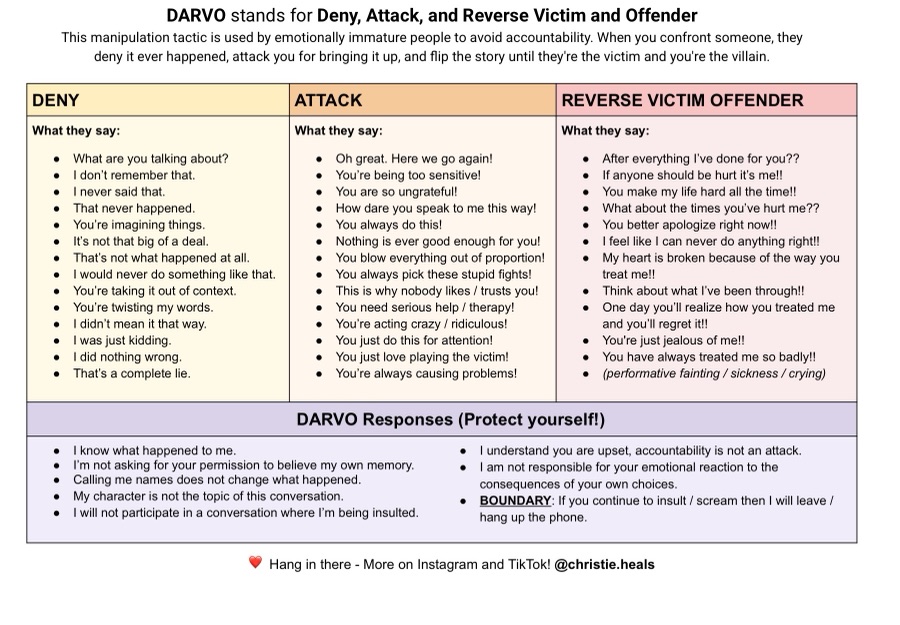
The DARVO cheat sheet.
What each step sounds like in a real conversation, and exactly what to say back. One page, free. Enter your email and it downloads right away.
- The three moves: Deny, Attack, Reverse Victim and Offender
- 40+ real phrases to listen for
- Responses that protect you, plus a boundary line
That didn't go through. Check the email address and try again.
Enter your email to get the cheat sheet.
We save your email so Christie can reach you. No spam. Privacy. Want the full community? Join the Patreon.Responding to DARVO, answered.
How do you respond to DARVO?
Stay on what you know happened, refuse the new topic, and stop explaining. Say one calm line such as "I know what happened to me," do not defend your character, and if it escalates, set an if-then boundary ("If you continue to insult me, then I will leave") and follow through.
How do you counteract DARVO?
You counteract it by not playing along with the topic change. Name your reality in one line, decline to argue evidence, and hold a boundary. Learning what DARVO looks like also helps: in one published experiment, people who had been taught about DARVO rated the perpetrator as less believable than people who had not (Harsey & Freyd, 2020).
How do you respond to someone playing the victim?
Do not defend yourself against the reversal. Try: "I am not responsible for your emotional reaction to the consequences of your own choices." Then return to what you raised, or end the conversation with an if-then boundary.
Should you tell someone they are using DARVO?
Christie says no. She says it is not your job to explain DARVO to the person doing it, and that they will not take it in. Name the pattern for yourself, and use a short line with them instead.
How do you respond to DARVO over text?
Keep it to one short message, answer only what you raised, and do not respond to each accusation. Something like "I know what happened to me, and I am not going to go back and forth about it" is enough. Save the thread.
What is reverse DARVO?
Writers use "reverse DARVO" in different ways: some mean a technique for resisting DARVO, others mean someone turning the label back on the person who named it. It is not a research term. Being told "you're the one doing DARVO" does not settle who is right; look at who did the original thing and who is willing to listen and repair.